
Ultrasound workflow performance depends on more than equipment, scheduling, and exam volume. It also depends on the person performing the exam and how consistently expertise and support are available during image acquisition.
As ultrasound departments manage workforce shifts and distributed care models, many leaders are exploring virtual ultrasound collaboration tools to provide more system-use mentorship during image acquisition.
Why experience gaps are growing in the ultrasound workforce
According to a recent analysis of sonographer resumes, 25% of have been in their current job for less than one year, and 24% have been in their current job for one to two years.1 In other words, about half are within their first two years in role. (Note: These figures reflect tenure in a sonographer’s current role, not total years in the profession.)
That experience mix matters because early-in-role clinicians are still building skill, speed, pattern recognition, and confidence across exam types in daily ultrasound workflow. It’s common for newer sonographers to take longer, capture additional images to confirm completeness, double-check settings, or pause to validate their work especially for complex cases. Those behaviors are not mistakes; they are part of learning.
Across a department, however, small differences in confidence can create operational ripple effects. Exam times become less predictable, and image sets can vary from one clinician to the next. That variability can influence radiologists’ efficiency if they need to spend more time verifying completeness, requesting additional views, or interpreting studies that are less consistent in structure. In that way, a confidence gap in acquisition can translate into friction in interpretation and reporting, even when everyone is at the top of their game.
Why ultrasound mentorship is challenging in distributed imaging teams
Departments can’t simply wait out a workforce that’s earlier in tenure; that reality will likely remain part of ultrasound staffing for the foreseeable future. The practical question becomes how to support these sonographers in the moment, so confidence develops faster, variability decreases, and downstream workflow is protected.
This is increasingly difficult in today’s distributed imaging environments. Ultrasound teams often span multiple rooms, sites, and schedules, including outpatient centers and decentralized care settings. Experienced lead sonographers, subspecialists, and radiologists can’t be physically present for every exam, and informal over-the-shoulder mentorship is harder to sustain when expertise is concentrated in one location and scanning happens everywhere.
When real-time coaching is unavailable or inconsistent, variability tends to persist. Newer clinicians may hesitate, over-acquire, or under-acquire. Senior staff may be pulled into ad-hoc troubleshooting and retrospective feedback that comes too late to help the exam in front of the patient.
Closing the confidence gap requires a way to enable real-time system-use mentorship and second-set-of-eyes support across sites, without requiring everyone to be in the same room at the same time.
How virtual ultrasound collaboration enables real-time mentorship
Virtual ultrasound collaboration is a practical way to extend ultrasound expertise across a distributed ultrasound team by bringing system-use guidance into the exam workflow, regardless of location. Instead of relying on chance proximity, delayed feedback, or scheduling a teaching moment after the fact, clinicians can connect with an experienced colleague when questions arise during acquisition. This helps newer team members build confidence faster, supports more consistent studies across staff and sites, and reduces avoidable downstream friction tied to variation in completeness or technique.
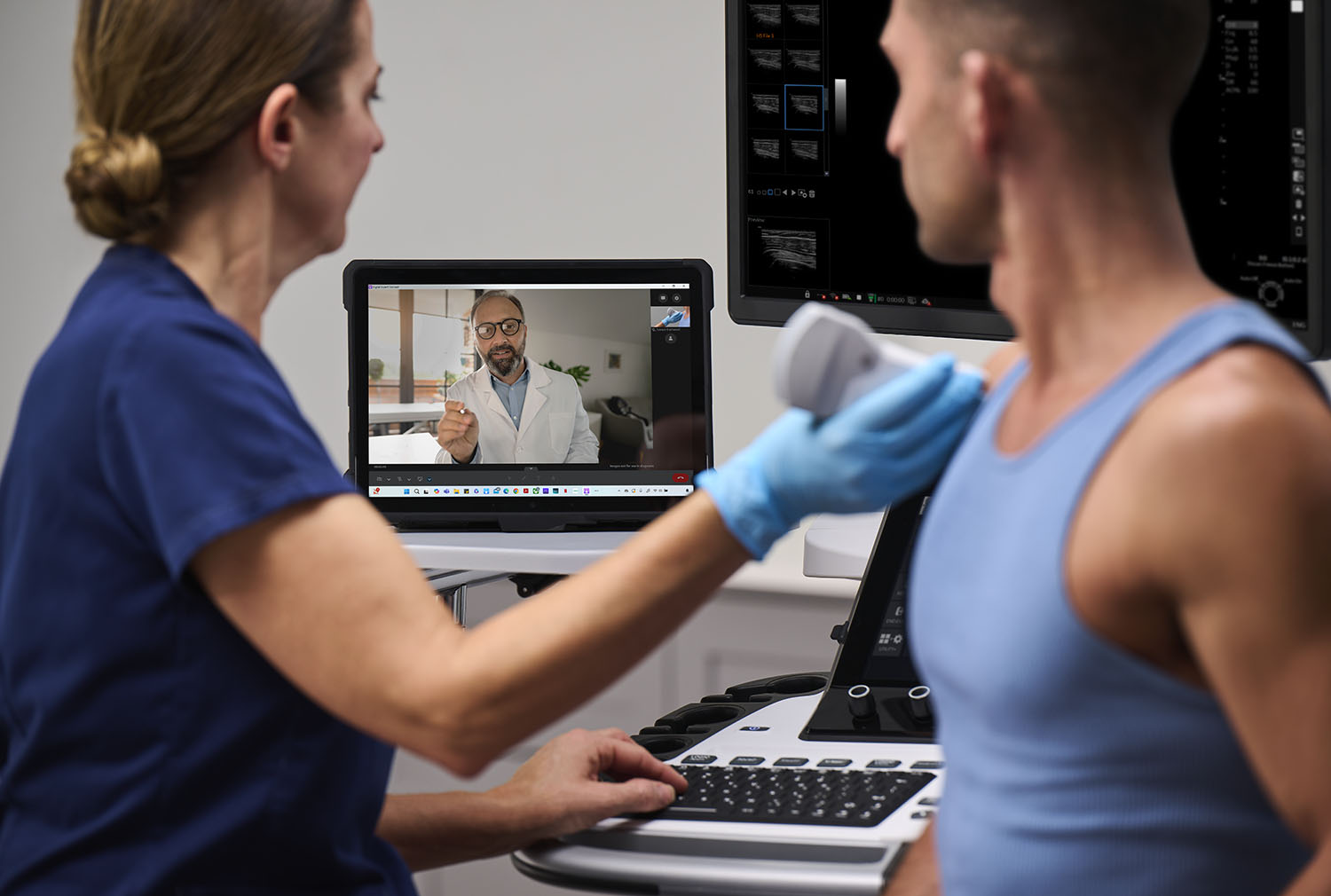
In this model, a senior sonographer, radiologist, cardiologist, or subspecialist can join an exam virtually to provide acquisition-level support. The intent is not diagnosis or oversight. It is to provide system-use feedback that help the scanning clinician better understand protocol expectations and move forward with greater confidence before the exam is closed and images are sent for interpretation.
A virtual ultrasound collaboration platform built for real-time collaboration
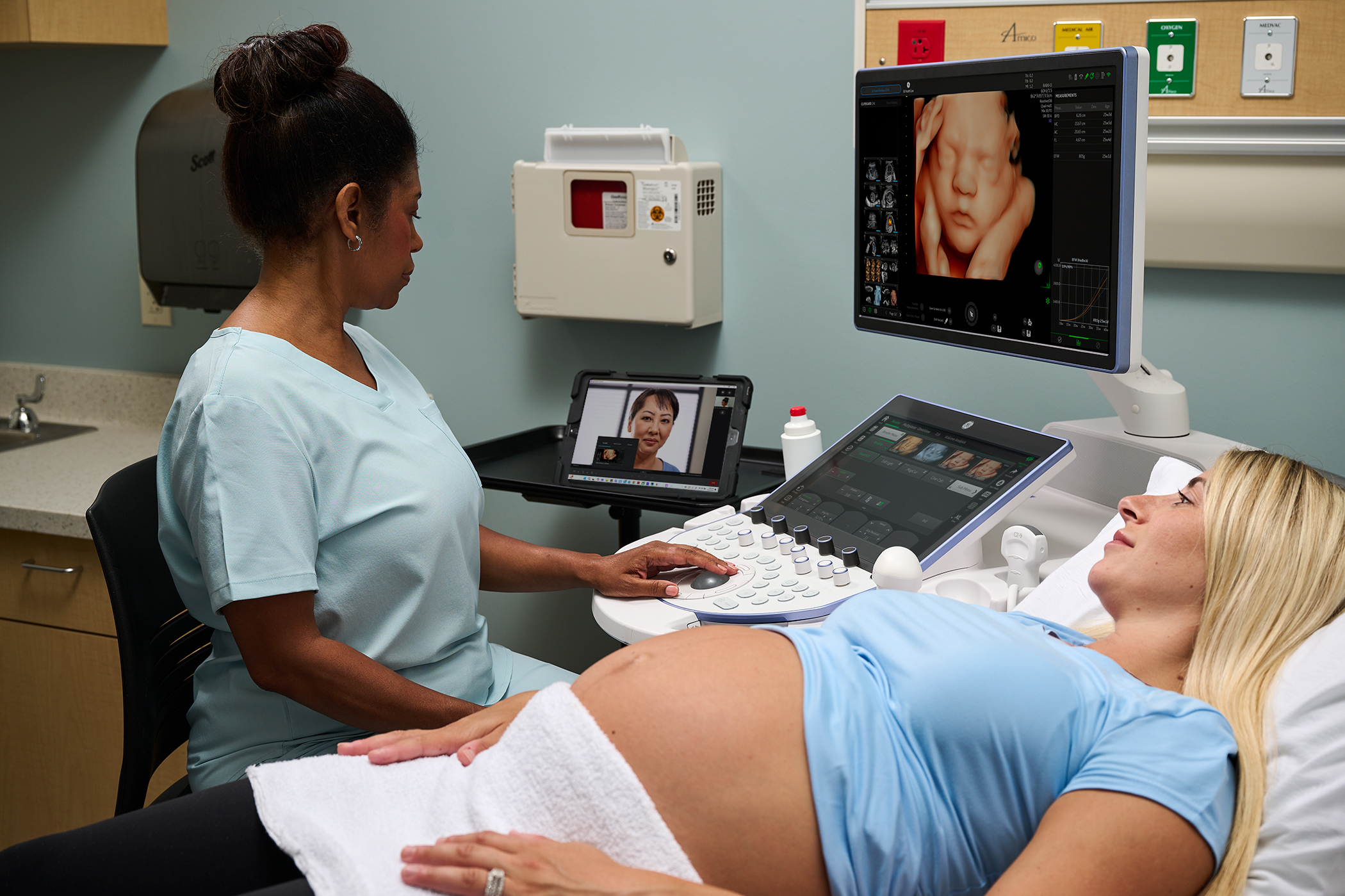
VerisoundTM Collab* is GE HealthCare’s virtual ultrasound collaboration platform designed to support real-time clinical collaboration during ultrasound exams. Using a tablet connected directly to the ultrasound system, clinicians can connect before, during, or after an exam through live audio and video communication, screen sharing, chat, and on-screen annotation. By making expert guidance easier to access across rooms, sites, and shifts, Verisound Collab helps departments reinforce best practices and build more consistent performance without requiring everyone to be in the same place at the same time.
How real-time mentorship can improve ultrasound workflow efficiency
When mentorship is available in the moment, several meaningful ultrasound efficiency levers can be adjusted.
Newer sonographers can validate technique and exam completeness as they scan, reinforcing learning immediately rather than waiting for delayed feedback. Experienced clinicians can extend their expertise across sites without leaving their primary location. Radiologists can provide system-use input that helps reduce variability before images ever reach the diagnostic viewer.
Over time, this shared engagement may help standardize image quality, reduce uncertainty, and support more consistent collaboration between ultrasound and radiology teams.
Expanding ultrasound expertise across care settings
Virtual collaboration also supports evolving models of care. In hub-and-spoke environments, a sub-specialist based at a central facility could provide real-time system-use feedback on exams that are being performed miles away. In rural or underserved areas, clinicians may gain access to expertise that would otherwise be unavailable.
Importantly, this collaboration complements existing workflows. Images still follow established processes for diagnostic interpretation. Virtual mentorship focuses on strengthening acquisition quality upstream, where confidence and consistency begin.
Confidence as a foundation for ultrasound efficiency and quality
In modern ultrasound practice, collaboration is not just about convenience. It’s about ensuring ultrasound expertise is available in the moments that shape image quality and confidence. By embedding system-use mentorship into the workflow through virtual ultrasound collaboration, organizations can connect sonographers, radiologists, and subspecialists as a unified team, even when they aren’t in the same room.
REFERENCES
1. “Sonographer demographics and statistics in the US,” Zippia, the Career Expert, last modified March 27, 2026, https://www.zippia.com/sonographer-jobs/demographics
*Not intended for diagnostic use
Verisound is a trademarks of GE HealthCare.
Product and features may not be available in all countries and regions. Full product technical specification is available upon request. Contact a GE HealthCare representative for more information.
JB37828XX
